On this auspicious Krishna Janmashtami, we celebrate Sri Krishna as the ultimate manifestation of Paramatma, Parandhama, Parabrahma. He is a complete manifestation of the ultimate supreme. He is beyond any words can describe; any word you try to describe him will be lower than his existence. No word can truly describe him. All the anashas of Paramatma manifest through one being, one incarnation, and that is Sri Krishna.
He is the embodiment of primabaki, the embodiment of life. He is so life-positive, so charismatic, such an extreme loving, caring thiagi.
Krishna’s Paradoxical Leelas
Krishna’s life is beyond paradox.
- He gives tremendous pain through his love.
- He gives tremendous bliss to those who hate him and those who love to hate him.
Consider the pain he gave to the Gopikas. At one point, Krishna decided to move out of Vrindavan just because the Gopikas could no longer be around him. He had grown up (he was 9 years old) and their families would not be able to handle it. He felt it was better to be physically away than to be near them and for them to be unable to enjoy him; that would have been too much pain. Even when he was there, the love he gave became such deep pain when he left. Yet, the Gopikas and Gopas knew, even in this, he was trying to reduce continuous pain.
Whether you love to hate him or hate to love him, he gives liberation. Whether you only love him or only hate him, he gives liberation. He is all auspicious qualities put together and is beyond all qualities, absolutely life-positive.
Strategic Actions and Divine Will
- Bhisma: Krishna picked up his Sudarshana to kill Bhisma. But when Bhisma fell to the ground, he chanted the Vishnusahasranama. Out of a thousand names, 700 directly describe Sri Krishna; it is actually Krishna Sahasra.
- Karna: Karna knew Krishna had taken away all his defenses. The last defense Karna had was only the punya (merit) he did, which was protecting his life. He knew it was Krishna standing in front of him asking for all the punyas. Karna did not think twice. Usually, when someone asks for dana (charity) and is standing on the left side, he would pick up with his right hand immediately. This time, he pulled the arrow from his chest using his left hand, and used his right hand to hold and collect the blood to offer it to Krishna – all the punya of his dharma. He took only a micro-millisecond, just to hold the blood. When you give something intangible, you need to offer it with water. Since he was on the battlefield and did not have water, his immediately available liquid was his blood, which he offered to Krishna. If you read the shloka, it says forever, all the punyas he did, not just in the body of Karna, but forever, he offered to Krishna.
- Drona: Drona knew Krishna played the drama to make him drop his weapon and sit on the battlefield. Krishna commanded, “Drop the weapon, it is time you give away, move on,” so Dharma could win. Drona just accepted the power by Krishna’s word and did not pick up the weapon. After Yudhisthira said “Ashwatthama is dead,” Drona was trying to look into Yudhisthira’s eyes to confirm, even though he knew Yudhisthira never lied. Yudhisthira was not looking into Drona’s eyes, so Drona doubted if Ashwatthama was not dead and thought he should pick up the weapon again. Then Krishna commanded, “Drop it,” and Drona, an enemy conspiring to kill, just dropped it. He decided not to pick up the weapon.
The Mahabharata War and Its Aftermath
No one can understand how the Gita, an absolute life-positive scripture, made Arjuna wage the largest world war in quality and quantity. The number of people who died in the Mahabharata war is much more than World War I put together and more.
It is now known that Neolithic Y-chromosome bottleneck research is proving geneticists are discovering precisely during the Mahabharata war time, after the Mahabharata war, the world experienced a dramatic collapse in male genetic diversity. This is now called the Neolithic Y-chromosome bottleneck. Astronomical data embedded in the text has led researchers to date the war of Mahabharata to October 16th, 5,561 BC. Precisely after the war, only one in every 17 men survived this genetic collapse. Nearly all male bloodlines were wiped out within a short window of time. The global population then was about 10 million, yet the loss was so severe that if it happened today proportionately, it would be like 235 million men. Proportionately, it was larger than World War I put together and more.
Krishna’s Mission: Protecting the Planet
Krishna’s mission was to save the Bhumata (Mother Earth) and protect her for the larger good. He sacrificed even his own son and his clan.
He didn’t just casually engage in philosophies. He delved into the depth, depth, and sarbhasha. Sarbhasha means commentary, expanding and elaborately explaining. Condensing means giving the essence.
- Ramanujacharya gave the condensed essence of the whole Vedas as 108 Upanishads.
- Vyasadeva, a unique incarnation who came before Sri Krishna manifested and lived in the body even after Sri Krishna left, gave the condensed essence of the Upanishads into Brahma Sutra.
- Krishna then gives the condensed essence of Vedas, Upanishads, Brahma Sutras, and commentary of Vedas, Upanishads, Brahma Sutras. It is not just a condensed version; it is elaborate and condensed both simultaneously and spontaneously.
Anything about life – above the sun, below the sun, between the sun, in the sun, outside the sun – anything you want to know the ultimate truth, ask Bhagavad Gita, read Bhagavad Gita. It is an unabridged, complete dictionary of world philosophy.
Krishna: The Ultimate Hero
In modern terms, Bhagavad Gita is like a commercial masala movie where romance, fight, spice, and adventure are all present. It’s the best commercial, all-masala movie. You can’t write any cinema story leaving the aspects of Krishna’s existence. He is the best ever-lived masala movie of the universe.
He starts with absolute love and sacrifice. For love, he chooses Devaki and Vasudeva, knowing both of them are in prison. Why should he take birth in prison? But the love of Devaki and Vasudeva, their bhakti, is paramount. Bhagavatam clearly describes he appears as Chaturbhuja Narayana with Shankha, Chakra, Sharangi, and then becomes a baby, enters into Devaki’s womb, and comes out from Devaki’s home. He could have chosen directly Yashoda, but he didn’t. He didn’t need to take so much risk, but love and sacrifice is a thriller movie. Every line is a thriller. He makes you sit on the edge of the chair; you can’t predict the next move and you don’t know what will happen. Every episode is an absolutely romance, thriller, comedy, what not—all the emotions you can imagine at their peak.
The Puranas and Krishna’s Influence
All web series and heroes written about are nothing but one small verse from Krishna’s life expanded into a whole hero serial. There is nothing newly discovered, invented, or creatively done in those hero serials other than Bhagavatam. Actually, there is no Purana with any creativity other than Bhagavatam. All Puranas are written by Vyasa, and Bhagavatam is also by Vyasa, so no disrespect intended. But the truth is, no Purana, whether it shows the valor of the hero, his love, his tyaga, his romance, his compassion, his strategy, his purity – all Puranas are just expansion of one or two verses of Bhagavatam.
He has compiled and presented Bhagavad Gita in such a beautiful way. All world philosophies are nothing more than the expansion of a single word of Bhagavad Gita. Not even a single verse, a single word. You can’t develop any more Purana stories, cinema stories, creativity, art, anything after Krishna’s advent. Philosophy, theology, theory, any investigation into the truth after Gita is revealed – Krishna is the ultimate word for hero to define the word hero. The ultimate definition is Krishna. He is the ultimate story of a hero. Bhagavad Gita is the ultimate word of world philosophies.
Krishna: The Man, The Message, The Mission
Krishna the man, Krishna the message, Krishna the mission. Nobody else has established dharma so powerfully. Everyone tries to say Krishna Janma happened to reduce the bhubhara (burden of the earth). No, Krishna Janma happened to protect the universe, to protect planet Earth.
At the time he manifested, the knowledge of Brahmastra was normalized. Any dhikkaras (irresponsible people) had knowledge of Brahmastra. Ashwatthama, just because he’s agitated, picked up Brahmastra. It’s like today how atomic weapons, which all countries have piled up, can destroy planet Earth 700 times. If these atomic weapons come into any madman’s hand, we don’t know what will happen.
Similarly, there was a time when Brahmastras, Narayanastras, were normalized. People who didn’t have a larger vision about the universe, life, humanity, or planet Earth, all started having access to these astras. One Brahmastra is at least equivalent to a trillion atom bombs. So, Krishna had to destroy all weapons in a controlled condition without destroying planet Earth. He needed to save Bhumata.
He once came as Varahavatara and brought the Bhumata out of the black ocean. Now, he happened as Krishna and brought Bhumata out of the collective negativity where too many people, without responsibility, had power like Brahmastra, Narayanastra, Pashupatastra, and other weapons. So he creates a controlled condition. His energy field brings all those who are irresponsible, not responsible enough, but have knowledge of these great, dangerous weapons. He finishes off all the weapons and them both, leaving only those responsible enough to handle the weapons to live. At the end of the Mahabharata, only three were left with the knowledge of Brahmastra: Arjuna, Ashwatthama, and Krishna. Ashwatthama was already cursed and silenced; his third eye was plucked by Krishna personally, of Brahmastra. Krishna knows both Arjuna and Ashwatthama would be very responsible. Other than these two, no one else with the knowledge of Brahmastra was left to live. He protected the planet Earth. If we are having planet Earth now, you are indebted to Krishna. The whole humanity is indebted to Krishna.
Krishna’s Unconventional Nature
He is an extraordinary synthesis of lover and warrior, mystic and statesman, innocent child and supreme intelligence. He transcends all conventional opposites. He holds both the flute (love and celebration) and the Sudarshana Chakra (protection). He is beyond duality. He is total life affirmation. He is the ultimate tyagi and absolutely celebrating and enjoying every dimension of life – material, emotional, intellectual, spiritual – without suppression or division.
He had 16,000 wives but declared himself an Akhanda Brahmachari. He protects Arjuna even though Arjuna messed up millions of times. Arjuna incurred many curses from many people. Without even knowing Jayadratha killed Abhimanyu, Arjuna declared that if he did not kill Abhimanyu’s killer by the next day’s sunset, he would enter the fire, meaning he was putting a curse on himself. But Krishna goes and protects the Pandavas from all kinds of curses they put on themselves or others put on them.
When it came to his own clan, his son played games with Durvasa, and Durvasa cursed him. Krishna let his son suffer the curse. Durvasa was actually supposed to curse Draupadi because he came for food, and Draupadi had only one grain of rice. She called Krishna, and he appeared, took that one grain, and fulfilled himself and all of Durvasa and his disciples. All of them suddenly felt full and were ashamed to go to Draupadi’s house for food because they couldn’t eat. He quietly left without coming back.
How many situations: before the curse comes, he saves sometimes; after the curse comes, he saves sometimes; the curse put on themselves by themselves, he saves. What a leela! He has not picked up any weapon, but he used his very words as a weapon and finished Bhisma, Drona, Karna. You can never imagine personalities like Bhisma, Karna, Drona could fall.
Sacrifice and Compassion
He sacrificed, getting blamed, abused, accused, but decided to fulfill his mission and fulfilled it. His mission was to save the Bhubhara and protect the Bhumata for the larger good. He sacrificed even his own son and his clan. Dwarka had two kinds of population: Guruvari (those deeply attached to his personality who went and settled in Dwarka) and those who were born into his family. He sacrificed his family, but those who were very attached and went and settled with him – those 16,000 wives – all of them were saved, protected, and sent to Ainabara safely under the guidance and protection of Arjuna.
When they were moving, all the precious jewels they were carrying, gifted by Krishna to his 16,000 wives, were robbed by robbers, and Arjuna could not stop them. Later, Arjuna asked Krishna why this happened. Krishna said, “They don’t know, those jewels are filled with my memory. They won’t be able to handle every time being reminded about me through those jewels. So I want them to live in peace till they reach Goloka back”. Even taking away the jewelry was compassion, reducing their pain. How to explain?
He is the greatest mystic, spiritual master, and statesman. The greatest statesman, absolutely dharmic, eternally compassionate, non-violent. The most non-violent man is pure celebration as spirituality, non-seriousness with sincerity. His life is a divine play, but every moment was very intense strategy. He approaches life and existence as spontaneous joyous play rather than a serious duty or burden. This attitude creates tremendous freedom, and the outcomes manifest exactly as he wants, allowing the natural flow. He is the ultimate alchemist. He knows how to put things together for the result he wants, very playfully.
Phases of Krishna’s Life
His whole life, if you see:
- Childhood in Vrindavan: 9 years (some scholars say 11 years and 6 months).
- Youth: 10 years and 6 months.
- Rule in Dwarka: 105 years and 3 months.
His whole life displays consciousness and action, spontaneous simultaneous synergetic manifestation of pure consciousness and action. Pure witness in Nirvikalpa Samadhi and pure Leela. The art of being fully engaged in life while remaining a silent, complete involvement without stickiness or identification. Karma (action) without doership.
He himself is a flute, and he himself is Sudarshana. Sudarshana intensely rotates, but the center is peace. Any chakra will rotate perfectly only if the center is centered in peace. He is a flute of the cosmos. He lived as an empty bamboo; the cosmos was using him as a flute.
His true dharma is inner alignment, not social conformity, but alignment with the ultimate consciousness in each moment. Acting from pure consciousness rather than any rules. It is too easy to act based on rules and social conformity.
People ask why Krishna had to move from place to place:
- First, Mathura (takes birth).
- Then goes to Vrindavan.
- Then again comes back to Mathura.
- Then again from there goes to Dwarka.
Because he never lived a social conformity life. He lived with pure dharma till he settled in a place where the ecosystem for those who are ready to receive him was built. He was moving around. Incarnations who live on the ultimate conscious centered have to create new ecosystems. They can’t go back to the same Ayodhya; they will have to create new ecosystems.
The Power of His Love
He is pure love manifestation. His capacity to give love and receive love and make people feel loved is ultimate. It is not that those Gopikas were without jealousy or envy; no, they had enough. But his ability to give love, receive love, and make everyone feel fulfilled. Literally, not just each Gopika who was in the part of the rasaleela says, each one had an individual Krishna exclusively for themselves. Even the 16,000 wives (16,008 wives) in Dwarka say individually they had Krishna exclusively for themselves.
This is the greatest achievement of Krishna than conducting a Mahabharata war and in controlled condition eliminating all the Brahmastras and weapons and saving the planet Earth. Saving the planet Earth is too easy compared to saving himself from 16,008 women. When a woman falls in jealousy, they will go to any extreme. But he was able to make all 16,008 women experience him as exclusively available for them. His karishma was such. What a personality!
It’s not that only Gopikas were jealous. Gopas equally enjoyed Krishna like Radha, nothing less, nothing more. Arjuna equally enjoyed Krishna like Satyabhama and Rukmini, nothing less, nothing more. And Arjuna was jealous of Draupadi and Krishna’s relationship, the kind of love they enjoyed.
He protected Pandavas in every way and also gave them the freedom to do what they want. Many people ask why Krishna couldn’t have avoided the whole gambling and protected Pandavas from losing the kingdom and everything, especially Draupadi’s Vastrapaharana (disrobing). But when Duryodhana said, “My mama Shakuni will play on behalf of me,” Arjuna said, “Let us call our mama Krishna to play on behalf of us”. But Dharmaraja said, “No, I’m feeling ashamed to play gambling in front of Krishna. It will not be dharma enough, it will not be respectful. Let us play by ourselves”. This fellow mentally made a sankalpa that Krishna should not know that Dharmaraja was playing gambling. So Krishna thought, “Okay, you don’t want me to know, so I will also be such a way that I do not know”. He protected, and at the same time, gave enough freedom for them to mess up. And any level of mess up they do due to their freedom, even after all that mess up, if they come back to him again, he is ready to protect them and get them out of all the mess ups they did. He could have said, “No, this whole mess up is because you played the gambling, you did the gambling without my permission, my knowledge, so suffer your karma.” No, he said, “All right, I will do what has to be done”. He starts cleaning up each of the mess through his strategies. What a personality! Purushottama is a small word, Purnavatara is even a small word.
He equally celebrated all genders, and all genders equally celebrated him. Not just Gopikas or Arjuna or Gopas, even Shikhandi. There is a story: Shikhandi was supposed to be brought to stand in front of Bhisma so Bhisma would drop his weapon. So Krishna tells, “Hey, bring her behind the chariot, through the backside she should enter into the chariot”. But any warrior is supposed to enter through the front side, and the rule is the charioteer should give the hand to climb into or climb down from the chariot. Krishna says, “No, let her climb through the backside and come to the front”. After the war is over, after Bhisma was done, Shikhandi asks, “Why did you do that?”. Krishna says, “Hey, you have a deep crush on me. If your hand touches me, you will become female, your Napunsakatva (impotence) will be lost when you become female completely. You will not wage war at that time”. Or, if you lost your Napunsakatva and become a male, Bhisma would not drop the weapon. “I need you till Bhisma drops the weapon. That is why I did not give my hand to you. You need to know the deeper secrets”.
Similarly, after the war is over, everything is done, victory is announced, the last travel on the chariot. They reached. Now, as per tradition, Krishna has to get down and give his hand for Arjuna to get down from the chariot. Arjuna expects that respect, “After all, it’s my chariot, I am the warrior”. Krishna says, “I’ll get down.” Arjuna was shocked, but he knew what Krishna said he had to do. Arjuna got down. Then, after that, Krishna jumps out of the chariot. The moment Krishna jumped out of the chariot, the chariot blasted into thousands of pieces and disappeared. Arjuna was shocked and asked what happened. Krishna said, “Hey, because I was on the chariot, Hanuman was in the flag. And because Hanuman was on the flag, all the weapons sent towards your chariot were not destroying your chariot. The moment I step down, I know Hanuman will fly off, all the weapons which are waiting around the chariot, the divine astras, will destroy your chariot. If you are there in the chariot, you would have been dead by now”. So sometimes he does not follow the tradition to kill the enemy, sometimes he does not follow the tradition to protect. He is a strategist, compassionate, and honoring the pain of others.
He could have easily finished off Gandhari’s curse. He didn’t need to accept Gandhari’s curse. He can stop Brahmastra, what is Gandhari’s curse? Nothing. But he wanted to acknowledge the pain of Gandhari, so he accepted the curse and allowed the destruction. He honored the pain of Gandhari.
Krishna’s Relationships and Teachings
His prema (love) is beyond any relationship labels. His relationship with Arjuna, or Draupadi, or Satyabhama, Rukmini, or even his relationship with Bhisma. Go and read Vishnusahasranama. Bhisma, an elderly man lying on his deathbed, in the thousand names, more than 700 are on Krishna, and more than 800 are full of romance. It is a pure love letter, an old Pitamaha, the great-grandfather of the Vamsa, on his deathbed writing a love letter for Krishna. Everything beyond anything you can imagine or understand.
He is not just synthesizing multiple spiritual paths. He is getting into the depth. In Gita: Karma Yoga, Bhakti Yoga, Jnana Yoga, even Tantric approaches. He represents synthesis and specialization both. Usually, those who synthesize become very shallow, superficial. But here, you see the depth, specialization, and synthesis in Bhagavad Gita.
And absolutely honest, brutally honest. After the Mahabharata war, after some time, Arjuna asked, “Oh Krishna, you revealed the Bhagavad Gita in the battlefield, I forgot much of it, can you repeat it?”. He says, “No, no, no, at that time I was in that samadhi, Paramatma Swarupa, so I revealed all the truths to you. Now I’m in Saguna Samadhi, even I cannot repeat the whole thing as it is. I can give you the gist”. This shows how harnessed he was. He says that pure samadhi operating, manifesting, I manifested. “Now I’m in Saguna Samadhi, come on, I’m in a playful mode, I’m in a different mood, so I’ll give you the gist, I won’t be able to repeat”. Absolutely grand and absolutely honest. This proves that he really gave Vishwarupa Darshan when he revealed Gita to Arjuna because he’s not trying to patch up, he’s not trying to cover up, he’s not trying to cook up. He said, “That time I gave you Vishwarupa because I was manifesting my Paramatma dimension. Now I’m manifesting Vasudeva Krishna dimension, I’ll give you the gist, don’t ask more than that”.
Actually, Krishna picked up weapons multiple times during the Mahabharata war. He picked up the chariot wheel once to threaten Bhisma. He picked up the Sudarshana Chakra to cover the sun. He picked up Brahmastra to stop the Brahmastra of Ashwatthama, to nullify it. Multiple times he picked up weapons. He could have just picked up the weapon and finished off Bhisma, but Shikhandi got the boon, so he wanted dharma to happen. He gave an opportunity for Shikhandi to revenge. His approach to Paramatma is through transformation, through awareness and consciousness.
The hollow flute he carries represents egolessness, allowing the existence to play through him. Music and dance become meditation when the player dissolves. The man Krishna, the message Gita, the mission protecting the sadhu – all three are unparalleled. Battling such a big war, he never missed a smile. He is the sacred integration of honoring all aspects of life. Krishna’s embrace of love, war, politics, spirituality – how to honor everything in day-to-day life.
Let us all offer our gratitude to Bhagavan Krishna who has happened for all of us!
source: Krishna Janmashtami Satsang
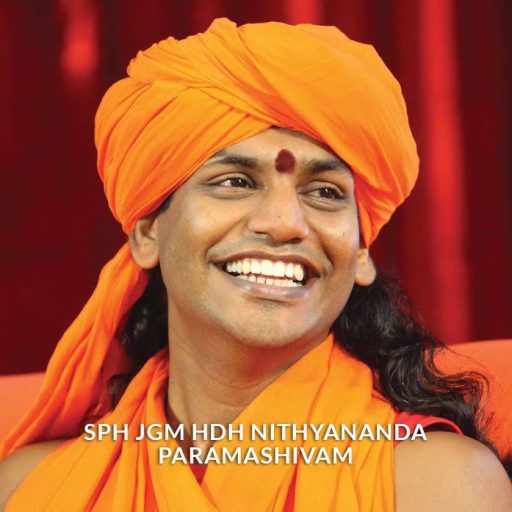
 KAILASA's Words of Eternal Bliss, Nithyananda!
One response to “Krishna Janmashtami: Celebrating Life and Spirituality”
Very dense material. I will have to spend much time to understand everything I study…!! Many names are unknown to me .
LikeLike