We will begin our exploration with a profoundly beautiful history from the Mahābhārat.
Once, the elders of the Kuru royal family decided they needed to test the intelligence of their upcoming generation of princes—the Kauravas and the Pāṇḍavas. They wanted to determine who possessed greater intelligence and wisdom: the Kaurava children, who were the hundred sons of King Dhritarāṣṭra, or the Pāṇḍava children, the five sons of King Pāṇḍu. To that end, they devised a very specific competition.
They presented a challenge to all the young Kaurava and Pāṇḍava princes, declaring, “You will be given exactly one gold coin. With that single gold coin, you must completely fill your entire palace house!” This was the seemingly impossible test laid out before them.
The Kauravas accepted the gold coin and sat down together to deliberate. Naturally, throwing a hundred different brains at a single problem will invariably mess up any plan or program. You must understand: you can successfully have a hundred hands working together, but you cannot have a hundred brains trying to steer the same wheel. Let us be very clear on this cosmic truth—all the truly great things in this world are accomplished by the coordination of a hundred hands and a hundred legs, but never by a hundred conflicting brains. The guiding brain should only ever be one. In our own lives, unfortunately, we often operate with thousands of conflicting internal “brains,” but not a single hand taking action!
So, these hundred Kaurava brains sat together and began an intense process of discussion, argument, and eventually, infighting. “How on earth can we fill this entire house with just one gold coin?” they speculated. Each individual brain proposed its own strategy, only for that strategy to be immediately pulled down and criticized by another. Finally, after an exhausting amount of squabbling and sheer confusion, they arrived at a collective conclusion: “The elders are nothing but cheats! They are actively abusing us, trying to exploit us, and intentionally creating a scenario designed to make us feel like failures!”
After indulging in this entire drama of blaming others, wallowing in the feeling of being deprived, and acting as if they had been cheated, they finally made a decision. They figured that for a mere gold coin, the only thing they could buy in sufficient volume was hay grass—the leftover chaff of grains and paddy that remains after the crop has been harvested.
Meanwhile, the Pāṇḍavas sat together and immediately shifted into the space of listening and Dharma. Even though each individual Pāṇḍava was a peerless specialist possessing unmatched expertise in their respective fields, they always remained perfectly aligned under Dharmarāja, the embodiment of Dharma! You must deeply understand this: Yudhiṣṭra, the eldest of the Pāṇḍava brothers, is Dharmarāja himself—the definitive king and living embodiment of Dharma.
Listen closely! All five of the Pāṇḍavas are sons of Nature, born through immaculate conceptions of extraordinary Divine powers. Yudhiṣṭra is Dharma incarnate. Together with his four brothers, they embody the foundational four tattvas: integrity, authenticity, responsibility, and enriching. They are fundamentally empowered with the conscious powers of words, thinking, feeling, and living.
Bhīma, the son of Vāyu (the wind god), represents immense physical valor, the sheer strength of integrity, and absolute authenticity. Arjuna, the son of Indra (the king of the gods), is Nara incarnate—the highest evolved expression of human energy belonging to Nārāyaṇa, Lord Kṛṣṇa himself. Arjuna represents physiological power—the profound power of feeling awakened by intense responsibility! Both Bhīma and Arjuna represent totally different expressions of unique divine abilities. The raw ability to thrash an opponent is entirely different from the focused ability to aim perfectly! Arjuna, as the embodiment of physiological power, possesses the supreme ability to aim and shoot flawlessly, a feat which requires absolute mastery over the body, the mind, and the senses. Nakula embodies the highest sense of intelligence and the boundless space of possibility that is awakened by authenticity—the ultimate power of thinking. Nakula is recognized as one of the most brilliant strategic planners, the one who meticulously charts out all the war strategies. Sahadeva serves as the aligner of time; he is a phenomenal astrologer expressing pure integrity, which is the power of words. All of these extraordinary beings are always perfectly aligned under Dharmarāja Yudhiṣṭra. Precisely because they are inextricably aligned to Dharma, the Pāṇḍavas operate like a single unified brain possessing ten hands, all moving together united in the single purpose of expressing enriching, which is the ultimate power of living.
Listen! I am defining the very essence of Dharma right now. The power of your words, the power of your thinking, the power of your feeling, and the power of your living—this integrated power is Dharma. Dharma is the act of aligning yourself perfectly to the spontaneous flow of the Cosmos.
So, the Pāṇḍavas all sit together in perfect alignment with Dharmarāja and calmly discuss, “What material will fill the entire house and cost only one gold coin? If our elders say it can be done, then it must absolutely be possible.”
Please understand, it is possible to look at this specific test of intelligence from two entirely different frameworks of possibility. One group—operating from incompletion—looks outward and wails complainingly, “I think these elders are absolute fools. They don’t have a clue what they are asking us to do. They are just trying to prove that we are all small, incapable fellows.” This is the classic thought trend of the Kauravas. Then, there are the sons of immortality, the Pāṇḍavas. They look inward and wonder with reverence, “When elders say a thing, there must be a valid way. They are actively trying to teach us, to educate us, and to enrich us through this unique exercise. Because the elders said it, it is absolutely possible.” So finally, the Pāṇḍavas also decide on how to successfully fill their house using only one gold coin! Let us see precisely how they accomplished it.
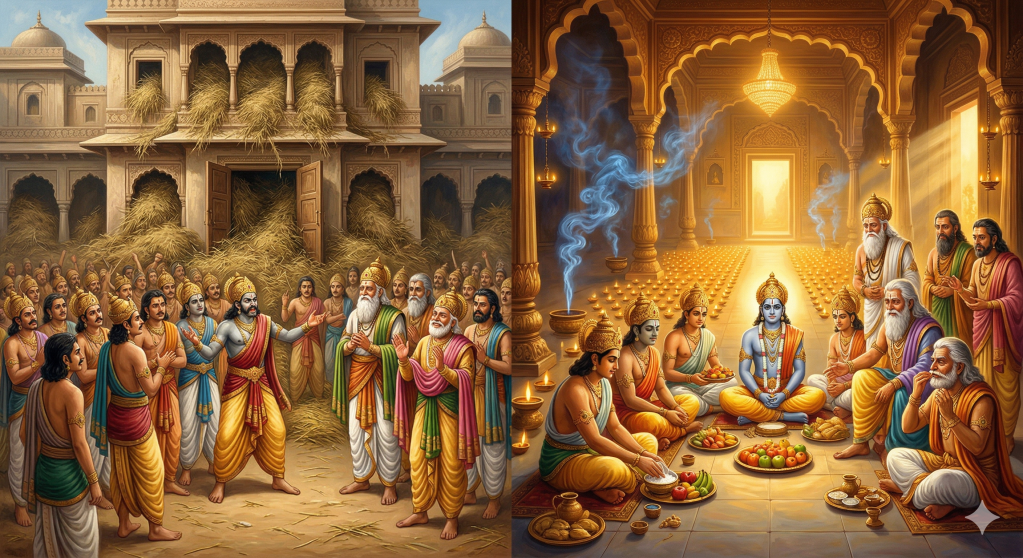
At the designated time of supervision, all the great Kuru elders—Grandsire Bhīśma, Droṇa, Vidura, and King Dhritarāṣṭra—assembled together. They first made their way to Duryodhana’s palace house. Upon reaching it, they saw that the entire house was completely stuffed full of hay, and all the Kauravas were standing outside in the yard! There was so much hay they could not even get into their own house!
Bhīśma asks them, “What happened here? Why are all of you standing outside like this?” The Kauravas immediately reply defensively, “What else could be done? You were the ones who told us that we had to fill the whole house with merely one gold coin; what else in the world can we possibly get with just one gold coin? So, we bought hay grass and filled it to the brim. Here, you see! We successfully won the competition!” And yet, all these “victorious” Kauravas are now standing outside, useless! Neither those hundred “smart” brains nor the esteemed Kuru elders are able to take a single step into the house.
Dhṛitarāṣṭra, the deeply attached father of the Kauravas, becomes instantly and overwhelmingly happy! In his blind attachment, he hurriedly concludes, “See my brilliant sons and their unmatched intelligence! They followed instructions and filled the whole palace house. They should immediately be declared the undisputed victors!” Droṇa, the royal teacher of both the Kurus and the Pāṇḍava princes, had once been a very poor Brāhmaṇa and was financially supported by King Dhritarāṣṭra. Consequently, whatever Dhṛitaraṣṭra says instinctively becomes the final conclusion for Droṇa; therefore, he simply agrees to the blind king’s hasty conclusion. But Bhīṣma steps in and stops Droṇa, saying firmly, “Wait! Let us go to the other house as well to see what they have done, and only then will we decide who truly won the game.”
Upon arriving at and entering the Pāṇḍava palace home, the elders are met with a completely different reality: they see that the whole house is brilliantly filled with radiating light and deeply perfumed with sweet, fragrant incense. Understand this profound strategy: for that single gold coin, the Pāṇḍavas bought beautiful earthen lamps, filled them with oil, and lighted them all up along with exceptionally pleasing, specially perfumed incense. The very moment the elders entered this divine space, the Pāṇḍavas reverently washed their feet, offered them comfortable seats, and served them fresh fruits. Enriching the elders in this deeply respectful manner, the Pāṇḍavas tell them humbly, “Please see, the whole house is indeed completely filled! It is filled everywhere with radiant light and with an exquisitely pleasant perfume and smell!”
Of course, the blindly attached King Dhṛitarāṣṭra is completely unready to accept this reality! Desperate to find a flaw, he goes to every single corner of the room, putting his sharp nose everywhere, smelling deeply to investigate if genuinely every corner is filled with the pleasant perfume. To his dismay, he finds that absolutely all the corners carry the deeply pleasant fragrance. Finally, the collective Kuru elders come to the unequivocally right conclusion and officially declare that the Pāṇḍavas have unquestionably won the game. The Pāṇḍavas stand victorious!
Please deeply understand and listen to this truth!
Completion is the profound act of creating an inner and outer space which is completely full—but importantly, a space where you can actually *Live*! Just as the physical space of the Pāṇḍavas is fully saturated with light and filled with an uplifting pleasant fragrance without being cluttered, so too is the inner space of Completion fully saturated with immense power and filled with the divine fragrance of bliss—*ānanda gandha*—a beautiful, expansive space where you can truly live and thrive.
Look at the story: both of those palace houses are technically “full.” In your own life, you also always keep yourself full with something; but the real question is, do you choose to keep your inner house full like the Kauravas, or like the Pāṇḍavas? You must find that out! Is your inner space resembling the Kauravas or the Pāṇḍavas? That is the entire crux! Have you simply brought cheap hay and stuffed it all around your inner house until you are suffocated, or have you consciously brought the uplifting, pleasant smell and the radiant light of consciousness within?
Please understand this psychological truth: Completion keeps you fully expanded and gives you a deeply fulfilled, breathable space in which to live vibrantly! Incompletion keeps you fully occupied, overwhelmed, and stuffed, but you are never fulfilled; you will never be able to actually live in that suffocating space. It is precisely because of their deep-seated incompletions that the Kaurava brains fight so violently with one another. Finally, when they simply get exhausted from fighting with their own incompletions, they become utterly confused and desperately jump to the completely wrong conclusion of filling their house with useless hay! In contrast, the Pāṇḍavas, who are brimming with the elevated space of Completion and filled with the vibrant power of living, beautifully and seamlessly enrich the elders and enrich themselves, thoroughly enjoying the light and the fragrance of their actions!
Please understand, modern-day CEOs and corporate leaders are constantly complaining that they are filled with stress. But what is this stress, actually? It is absolutely nothing but the act of filling yourself with mental hay! You are filled to the brim, but you are not fulfilled. You are constantly occupied, but you are not being truly useful. Before making a single decision, when you unproductively think about it two hundred times, you naturally become exhausted, exactly like those hundred conflicting Kaurava brains! Usually, when there are so many contradictory incompletions aggressively fighting within your brain, either your important projects completely die down, or they uncontrollably take a totally opposite and destructive turn!
You must consciously reduce the incompletions you continuously infuse into yourself; you must reduce the psychological abusal you do to yourself daily. Reduce the mental setup of the ‘Duryodhanas’ acting upon you. The ‘Duryodhanas’ inside you are nothing but a chaotic bunch of incompletions—they carry no real power! Actually, the Kauravas took the disastrous decision of buying the hay and filling the house simply because they were fundamentally unable to handle the overwhelming confusion and the fierce fighting amongst themselves. So, to escape the tension, they just blindly jumped to the worst possible conclusion, thinking, “Let’s just do *something*!” Listen carefully! Any decision that is made out of deep incompletion, simply in the panicked mood of “let’s just do something,” is pure suicide! So understand this clearly: “let’s do something” triggered out of incompletion, or out of the sheer restlessness generated by incompletion, acts exactly like pesticide! If you do it just for yourself, it is personal suicide; if you execute it for your family, it is homicide; if you do it for the masses or on a corporate level, it is genocide.
What the Pāṇḍavas achieved was born entirely out of the pure, unclouded space of Completion. I tell you as a cosmic truth, when you successfully create the inner space of Completion, in every single moment you give birth to a completely new way of thinking, a fresh new way of feeling, a profound new way of accessing knowledge, a vibrant new way of being, and an entirely new way of making yourself powerfully available to society and to all of humanity.
Look within yourself, and consciously create the space of Completion before ever coming to *any* conclusion! This is the paramount message and teaching of this chapter.
The sixth chapter of the profound Bhagavad Gītā, which is known as *Dhyāna Yogaḥ*, begins directly with Lord Kṛṣṇa’s words. Interestingly, in this specific chapter, Arjuna is not actively asking any questions to Kṛṣṇa. Rather, Kṛṣṇa is fluidly continuing His profound answers and revelations carrying over from the previous chapter.
 KAILASA's Words of Eternal Bliss, Nithyananda!
One response to “The Secret to Decision Making: Look Inward and Create the Space of Completion”
Swamiji, after hearing that story about the Pandavas and Kauravas, I feel like my inner house is stuffed full of hay—my mind is a battlefield with a hundred voices clashing: stress, doubts, panic decisions, no room to breathe, no way to step inside myself. I want to become like the Pandavas: one clear voice like Yudhisthira, my home glowing with light and fragrant with incense, no more fighting. Teach me a daily technique—how to light that lamp in a second, clear the chaos, create the space of Completion, and step into Dhyana Yoga from the sixth chapter of the Gita. Help me live it, because I’m done suffocating in this hay.
LikeLike