Breaking the Seesaw of Sensory Pleasures
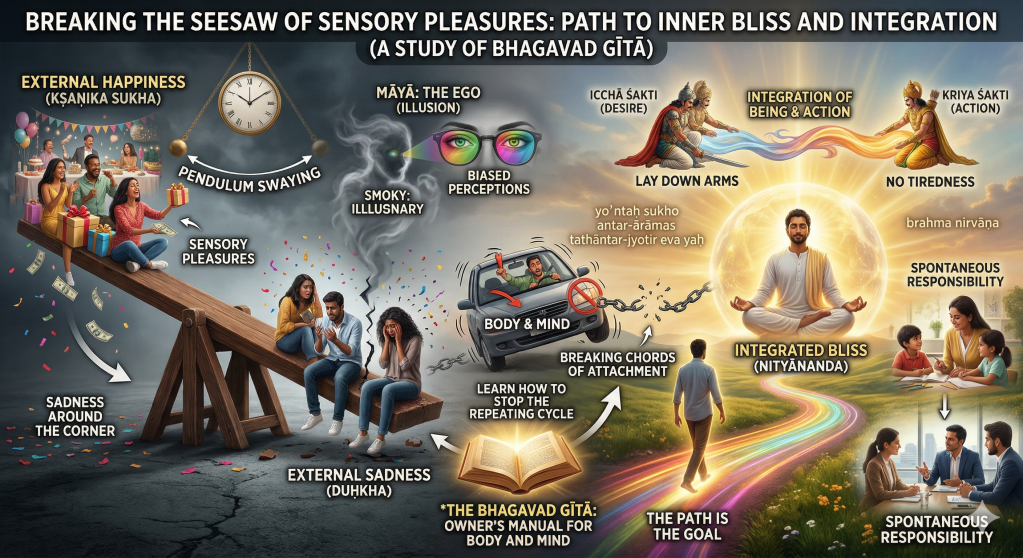
Kṛṣṇa says that sensory pleasures are bound to end; they do not last forever. Generally, we are controlled by what happens outside us. Our happiness is an emotion that is created by something outside of us—a pleasant situation, the presence of someone we like, and so on. When we experience happiness due to some event outside us, be very sure, sadness is around the corner. When we experience the joy in us because of an external source, we will experience sadness once that external source is taken away from us. We always attach our happiness to something that is external to us. If these things are taken away from us, we are left with sadness. It is like a pendulum swaying from one extreme of happiness to the other extreme of sadness.
The event and the person do not cause happiness and sorrow. It is caused by our sensory perception and by the judgment based on this perception. That is why the same event that may be joyful to one is sorrowful for another, and would leave a third one undisturbed. It is our attachment to that person or event and our judgment based on our patterns that creates the sorrow or happiness. The incident by itself is neutral.
There is a beginning and an end to these states of sorrow and happiness. But bliss is something that continuously happens in us for no reason. Bliss does not depend on external sources. It is inside us. Once we are centered in us, we are always in bliss. When we are constantly experiencing the inner joy or bliss, whatever happens outside us does not affect our space of bliss.
Conquering the Ego: The Root of Māyā
Happiness or sadness happens because of our sensory pleasures that are again a result of our mind and ego. Our ego, our false association of ourselves with various emotions is actually the cause of our misery. At the core of our beings is pure bliss. But we are functioning at our periphery and are not able to see this core. The ego is what is really meant by māyā or illusion. Yā mā iti māyā—that which does not exist but which troubles as if it exists is māyā. We don’t see reality as it is because we are all the time looking at life through glasses tinted with our biased perceptions, through our limited view of life.
When we start watching these sources with awareness and complete with our root patterns, we break the chords of attachment of our state of joy with these external sources and desires. When we are aware of what we really want, this dependency on sensory pleasures breaks. When we are centered and complete in ourselves, we start taking things as and when they come.
I am not saying you should not enrich yourself with the joy that you get from external sources or fulfillment of our desires. No. All I am saying is, be aware of it when it happens, that’s all. Do not attach your internal state of joy to these sense pleasures. If they happen, let them happen. Let them not dictate your state of happiness.
Bhagavad Gītā: The Owner’s Manual for Body and Mind
Kṛṣṇa gives us now a beautiful technique to reach that ultimate Kṛṣṇa consciousness, to reach the beautiful space of bliss. If we can, at least once, settle inside our being, into our space of completion, when we are attacked by this incomplete emotion of desire and anger, without moving our body, without cooperating, without being taken away by that emotion, we are well-situated. This means that we achieved what has to be achieved; we are blissful in this world.
People ask me again and again, ‘Swamiji, what is the purpose of this body and mind?’ The purpose of body and mind is only one thing: to achieve, to learn how to experience joy without body and mind. If we can learn to have happiness and bliss, without the body and mind, we have achieved the purpose of the body and mind; over! After that, we can throw away the body and mind; we can live without the body and mind.
The person who is able to live without the body and mind is called a jīvan mukta—a person living enlightenment. Even if the body and mind are with him, he will not be touched by them. Unless you have some reason, you will not assume this body. If you had a single glimpse of bliss without this body and mind, the bliss that is beyond this body and mind, you will never be disturbed by this body and mind. Even if it is there, it will be following you; you will not be following it.
It is like this: If you don’t know how to put the brakes on when you are driving the car, it means you are not driving the car, the car is driving you! Without reading the owner’s manual and learning to drive, if you sit in the car, you will only be in trouble. Only when you know how to start or to stop or apply the brakes properly, you are driving the car. Otherwise, the car is driving you. So read the owner’s manual before getting into the vehicle. The Bhagavad Gītā is the owner’s manual for your body and mind. If you read the owner’s manual before getting into the body and mind, you will be able to stop when you want to stop. You will not get into the accident of repeating the life and death cycle.
Finding Your Place Through Intelligence, Not Greed
Here Kṛṣṇa says: The man who is not moved, who can tolerate the urges of material senses, check the force of desire and anger, is well-situated and he is happy in this world. He knows where he is. He knows his place. In this world, many of us don’t know our place. That is why we feel uprooted. We don’t feel we belong to this life. We don’t feel we are at home because we don’t know our place. Only a person who has gone beyond greed and fear can relax into his being. He will know what his place is in this planet Earth.
If we don’t fuel our being with fear and greed, suddenly, we will see a new clarity. We will start working out of intelligence, out of Divine Consciousness, out of Eternal Bliss. Just decide, ‘Whatever I do out of greed will only result in more greed. I have been getting nowhere. Enough!’ In the same way, if we are escaping from something out of fear, decide, ‘Alright, how long can I escape? This fear will come and attack me in some other form. If I am afraid of this now, I will be afraid of something else later. So let me face it now.’
It is just the fear, not the object of your fear. You may escape anywhere but you are carrying the canopy of fear and greed with you. Man doesn’t need so much entertainment. If we need so many things to make us happy, there is something seriously wrong with the whole system. We need to look into the system and repair it. Again and again, Kṛṣṇa declares, ‘Let you live in the space of completion. Let you work out of bliss.’ And I tell you, if you are complete and work out of bliss, you will create bliss for yourself and for others; you will never know what tiredness is.
The Truth About Tiredness and Integration
Let me tell you honestly that I still can’t understand the meaning of the word ‘tiredness.’ Tiredness is the inner contradiction between the icchā śakti (power of desire) and kriya śakti (power of action), between your being and your action. Inside, there is a deep problem. Your greed and fear are attacking each other. The Mahābhārat war between fear and greed is happening within you. Man whose consciousness is complete can never experience tiredness. Why do we feel tired? We feel tired when we are not integrated within ourselves. One half of our being wants to express itself but we have suppressed it for various societal reasons. The other half is what is expressing itself in the manner that we are forcing it to. Because we constantly have to put in an inauthentic effort to be what we naturally are not, we become tired at some point.
Just integrate yourself. Be with completion rather than suppressing yourself, and there will be no unconscious half to fight with. Then where is the question of feeling tired? We feel tired only when we are not completely involved in what we are doing. Become complete, integrated, and whole. We feel tired only when there is a gap between what we are doing and what we want to do. When we are driven by greed for something, we are caught up in the goal. Or we are driven by fear of something; we want to escape from the object of fear and hence we are not completely involved in what we are doing.
We are continuously chasing power. First, let us get our body and mind under our control. As of now, it is under the control of fear or greed. Let that be controlled by us. Then, automatically, we can get anything under our control. One thought from greed or fear is enough: our body just runs. May you be complete with your body and mind!
Living the Goal: The Path of Spontaneity
Here is a beautiful technique from Kṛṣṇa to enter into the supreme consciousness: ‘Just be happy, restful and complete from within’, says Kṛṣṇa, yo’ntaḥ sukho antar-ārāmas tathāntar-jyotir eva yaḥ (5.24). Our happiness in every moment is measured only by greed or fear. This means we are not actually experiencing the moment of completion. We can enjoy something totally only when we are completely in it and we can be complete only when we are totally in the present moment. Bliss is the state of joy that has no reason and which is not affected by the past or future.
Understand, life in itself has no goal. The very life itself is the goal. The path itself is the goal. If we think the goal and the path are different, we will run towards the horizon. Can we ever touch the horizon? The more we run towards it, we will find it receding from us, because the horizon is imaginary, it is an illusion. But when we see life itself as a goal, we make the path itself as the goal. Every moment when we live with full completion, with full enthusiasm, with powerfulness, we actually enjoy that moment. When the path itself becomes the goal, we enjoy the goal also every moment.
Responsibility: The Song of Non-Duality
When we are tuned fully inwards, we no longer have any attachment to what happens outside; we are one with the All, the Existence, and we have transcended all karma. We are then in brahma nirvāṇa—the ultimate liberation, one with Existence, and we are in nityānanda, eternal bliss. When we feel genuine love for others, we feel responsible for everyone. The more responsibility we take up, the more we expand. Responsibility is something that can be easily shrugged. But if we don’t shrug it and keep on shouldering it with the right reason, we will expand and the divine energy will automatically flow in us.
Responsibility can happen to you only after completion. If you take responsibility because you have to be a performer, you will feel it as a weight. Whatever happens in and around you—you ARE the source! That is why you need to take responsibility for whatever is happening in and around you. You need to take responsibility because you are responsible, and not for any other reason. With this clarity, every action—from taking your children to school to business meetings—becomes a spiritual practice leading you to jīvan mukti.
Only when we go beyond the incompletions of the mind, beyond duality, we see the absolute oneness and synchronicity of the entire Existence and we start living in the state of Advaita. Our response to take up a responsibility is shaky when we are in a dilemma. We should take up responsibility spontaneously. The ability to respond spontaneously out of the space of completion is what I call responsibility.
 KAILASA's Words of Eternal Bliss, Nithyananda!