Puranas like Thiruvilayadal Puranam and Periya Puranam can be created. Can the minds of such people find flaws in the ultimate truth? What, does the Lord… “I will come to all those who call me, if they chant ‘Sivaya Nama‘ I will come immediately, there is no danger” — isn’t there the assurance given by the Lord? The assurances given by our three primary saints Appar, Sundarar, and Sambandar, the assurance given by Saint Manikkavasagar — what are all these? Because I am formed from the grace of Annamalaiyar as the grace of Annamalaiyar itself, with Annamalaiyar as witness…
I am telling you, listen. These Puranas… your qualifications, disqualifications, all these are just… for the Lord… If you study grammar properly, arrogance (talaikkanam)… Om Om Om. Ultimate manifestation Paramashiva — Gajamukha Anugraha Murthi bless you all Paramadvaita. All the Paramashiva Sena participants in Kinipisa Kailasa, Kinipisa Kailasa Thiruvannamalai, and all the chisabha members, rajyasabha members, Kailasavasis — blessings to each and every one of you. Paramashiva, ultimate manifestation, Gajamukha Anugraha Murthi bless you all — Paramadvaita prapti, sarva mangala prapti…
…sarvananda prapti, sarva aishwarya prapti, Sivajnana bodha prapti… Nithyanandeshwara Paramashiva Samarambham Nithyanandeshwari Parashakti Madhyamam Asmadacharya Paryantam Vande Guru Paramparam. Om. I bow to and welcome you all. I provide the basic introduction to enter the alchemy of enlightenment of this Thiruvilayadal Puranam Satsang. Understand these few fundamental truths. First, these events described in the Thiruvilayadal Puranam and Periya Puranam…
These Puranas Are Truth, Not Spiritual Poetry
…have documented the truth exactly as it is; understand that first. Here, neither the Thiruvilayadal Puranam nor the Periya Puranam is spiritual poetry. It is not a spiritual poem. The brainwashing done to us — that just because it is told in the form of poetry, it must be mixed with lies — fails completely before the Thiruvilayadal Puranam and Periya Puranam. Understand that well, sir. If you think this universe stops at the extent of what we see and understand with our five senses…
…there won’t be anyone else with such a massive lack of knowledge as you. Please free yourselves from that half-baked brainwashing — giving it the name ‘rationalism’ — free yourself from this half-baked brainwashing. Whether it is materialism, or atheism, or Lokayata… understand well, Lokayata is different and materialism is different. I am calling Western materialism as materialism. There is an Eastern materialism, that is Lokayata. In the East itself, in Eastern countries, there are two or three types of atheism.
Traditional atheism and modern-era atheism. If you look at this modern-era atheism, more or less, it is a brainwashing done with the intention that the Hindu religion must be destroyed, Sanatana Hindu Dharma must be destroyed. That is nothing but just an evil force. An evil force. There is no ‘stuff’ in it. To do a debate, to argue, to have honest arguments and counter-arguments, to conduct a Vakyartha Sadas (debate assembly) — there is absolutely no material there to do all that. Just an evil force, a thug gang, or political power…
…holding this hard power, capturing hard power, and with that momentum, an evil force destroying soft power, an extremist evil force — that is all it is. Apart from that, there is absolutely no contribution there towards arguments and counter-arguments, understanding, wisdom, or knowledge. That dimension itself is not there. So now look at this one by one; I will tell you stage by stage. That is, Puranas like Thiruvilayadal Puranam and Periya Puranam, having seen what happened in the various evolutions and dimensions of the universe, have directly structured the truth for us exactly as truth…
…and given it. You must understand one thing well. Neither Vyasa who created the Thiruvilayadal Puranam, nor Nilakantha Dikshitar, nor Thirupatra (Perumbatra) Puliyur Nambi, nor Paranjothi Munivar had any vested interest. A pure consciousness like them — that is, they didn’t have the need to seek anything for themselves, to prostitute their knowledge to attain comforts, fame, or any other benefit for themselves. I have used a slightly strong word; it’s okay, it’s not wrong. When telling truths, a strong…
…word coming out is not wrong. Therefore, committing an offense against the ultimate truth and using knowledge in service of that offense — all such actions are intellectual prostitution. Here, these four who created the Thiruvilayadal Puranam… many more have created versions of the Thiruvilayadal Puranam. Among them, I am taking mainly these four. I am taking them as the reference point, the baseline. Taking them as the foundation, I am conducting these satsangs. Neither Vyasa, nor Nilakantha Dikshitar, nor Thirupatra Puliyur Nambi, nor Perumbatra…
The Integrity and Purity of the Author-Seers
…Puliyur Nambi, or Paranjothi Munivar — because they had no expectation of any reward in any way, or any recognition or pride, because they had none of these reasons, because they were pure renunciates, because they were established in truth, because they were consecrated in truth, because they were not people who prostituted their knowledge — understand well, none of these four were court poets of any king. Not court poets of any government. Even though Sekkizhar was a minister in the court, when it came to this divine work…
…there was not even the slightest interference from the king in any way. If you look anywhere, he never compromised in shaping this ultimate truth into words. More than that, if we take these research books on Periya Puranam and flip through them deeply, in reality, Lord Sekkizhar, to write and study the life of every single Nayanmar, travels to each of those towns. In that era, traveling to each town and gathering information in that town… you must understand one good thing: Periya Puranam or Thiruvilayadal Puranam…
…are not just truths of wisdom. They have captured the society of those times exactly as a picture, sir. The detailing! When you look at the detailing they have gone into, and when you see how much effort they have put in for that detailing, the integrity of their knowledge! I will give a few examples. During Sekkizhar’s time, in many temples, the Goddess’s shrine was different; or it was not there. Exactly how it was at that time, he has documented it exactly as is. Geography, social structure — that is, geographical structure…
…how the town’s structure was, how the town’s natural layout was, how the town’s political structure was, how the town’s social structure was, how the town’s spiritual structure was. How detailed and how deeply he has documented all of this! The effort that Lord Sekkizhar, Vyasa, Perumbatra Puliyur Nambi, Paranjothi Munivar, or Nilakantha Dikshitar have taken for this documentation — just looking at it shows. The extent to which they were determined that truth must be documented exactly as it is.
Reclaim Your Right to Soulfulness
If people who had the intellectual chastity and intellectual integrity to go and see a town right in front of their eyes on this earth — like Thiruvarur — and document only what is there, would they document just Devaloka and Sivaloka out of mere imagination? First, O Tamil race, the most brutal attack and massive brainwashing conducted against you — that is, the genocide against your race, in that genocide conducted against you…
…escape from it and come out. It is not enough to just escape with your life; escape with your soulfulness (uyirmai). Reclaim your soulfulness, your right to soulfulness. Your right to soulfulness is what Thiruvilayadal Puranam, Periya Puranam, and such things are. They are truth. These are records of things that happened, documented exactly as they happened. O Tamil race, for several hundred years, genocidal attacks have happened against you on many levels. I can tell you many levels. These genocidal attacks are not just wars alone. That is, our…
…the taproot of Sanatana Hindu Dharma is the temple. Focusing on the Vishwakarma clan — the clan that builds these temples — they have hit them and converted them, changed their religion. Because if they change their religion and leave, if the art of building temples is destroyed, that is enough to destroy Sanatana. They planned like this, and planned. This didn’t happen in one or two days. That is why many of you don’t understand this. Because I am someone who has immersed myself in this field and extracted pearls for the past 40 years, having built temples in hundreds of places worldwide, if you calculate, the largest…
…makers of deities in modern times must be us, it must be Kailasa. We have made thousands of deities and consecrated them in thousands of places. I have been interacting for 40 years with those working in this field — those who make these black stone deities, and others working in this field. What they all say is just this: “In Kumbakonam and those areas, many areas, in the generations before us, many people of our clan were converted to other religions either by force or due to poverty,
Swami. Because of that, our lineage itself is destroyed.” Another thing is making this traditional education illegitimate — that is, making it unrecognized. I am telling this clearly and openly: Traditionally, from childhood, roaming around the parents’ workshop, holding the chisel, holding the hammer, while the father carves the deities reciting the Dhyana Shlokas of the Agamas, the mother placing the chisel in the furnace, boiling it and heating the chisel and giving it, when the mother cooks and brings food to the father in the workshop, while giving food itself…
…feeding the child — the sculptures and deities made by children who grew up like that, their details, their beauty, their structure; and the boys who go and study in these modern-day colleges they run, the sculptures and statues they make, their structure. If you just look at these two, you will understand. That is, delegitimizing the traditional education system is itself a genocide. Committing genocide using the law. Creating something called law and using it to commit genocide. Lawfare. Understand this well. Ideologically…
…practically, in various ways, continuous genocide — the attacks conducted on our Sanatana Hindu Dharma. Continuously insulting the concepts of Sanatana Hindu Dharma, cheapening them, portraying them as lies, mocking and ridiculing them. Look at the entire media, sir! Whether it is movies, or television, look at the entire media, sir! With a few exceptions — some good people being there, and even they, struggling and stumbling… just like how V.O.C. borrowed money, gave his life to sail ships, similarly, some of the producers of that era…
…stumbling along, managed to produce a film like Thiruvilayadal, or a film like Nandanar, or a few films like Thiruvarutchelvar. But after that, how this evil force — screen, publishing, media, this and that — in this media, I mean print media, television, social media, everything — like an octopus, this evil force has occupied it and is destroying Tamils soulfully. Understand that. Only if you understand that, conscious sovereignty, soulful independence…
…reclaim it. Reclaim your right to soulfulness. Listen deeply. Only if you completely understand this brainwashing done to you, you will realize how evil forces have been eating you from the outside and the inside. For about three generations right here, sir! “Tamils have no connection with Sanatana Hindu Dharma” — what kinds of brainwashing! Making an issue between Sanskrit and Tamil — what kinds of brainwashing! This is not just brainwashing; it is genocide! O Tamil race, wake up! Reclaim your right to soulfulness.
Look how they have ruined it so there’s absolutely no ecosystem left to believe that Thiruvilayadal Puranam and Periya Puranam are truth, sir! Evil forces. Understand well. Just like Vyasa, just like Perumbatra Puliyur Nambi, just like Paranjothi Munivar, just like Nilakantha Dikshitar, just like Sekkizhar, I too have no needs; just for the sole purpose of documenting the truth and making it a reality for you, they spoke, and I too am speaking. Therefore, absorb what I am saying a little deeply.
Sekkizhar’s Multi-Layer Research Method for Periya Puranam
Reclaim your right to soulfulness, sir! I will tell you a little about Sekkizhar’s research; listen and understand. After that, I will also tell you about the research of Paranjothi Munivar and Perumbatra Puliyur Nambi. How they have all researched these books. Why I am bringing in Sekkizhar too: when talking about the Thiruvilayadal Puranam, we have to refer to the Periya Puranam along with it — there is no other way. The reason is, many divine plays that come in the Thiruvilayadal Puranam also come in the Periya Puranam.
Especially, everything related to Thirugnana Sambandar and Manikkavasagar comes in Periya Puranam as well. Because these two books overlap in some ways. That is why I am bringing up Periya Puranam. Because when I talk about the Thiruvilayadal Puranam, I am going to make references to the Periya Puranam as well. I am going to show many quotes from the Periya Puranam. That’s why I am bringing both. What all books I am going to use, their deep truth, the depth of their truth — only if I make you understand this, you will fully…
…plunge into the Purana and extract the pearl of experience. Sekkizhar does primary text research. The primary texts are the Thiruthondar Thiruvanthathi compiled by Nambiyandar Nambi, and then the Thiruthonda Thogai. Sekkizhar keeps this as the basis and does primary text research. Next, he does Thevaram research — the internal references mentioned about the Nayanmars in Thevaram songs. That is, even as Gnanasambandar, Thirunavukkarasar, or Sundaramurthi Nayanar sing, they sing referring to notes about these Nayanmars in many places.
So he researches all of that. If you look at Sundaramurthi Nayanar’s songs, he talks about the Nayanmars in many, many places in the Thevaram. He takes all of that as evidence. Next, Lord Sekkizhar goes from town to town. He does field research. If we have to name clear Puranas written in Tamil by doing field research, we have to say Periya Puranam and Thiruvilayadal Puranam. Very clearly, he travels all over Tamil Nadu. The towns where the 63 Nayanmars lived, the places where they were born, the Shiva temples they worshipped at — he goes in person and…
…observes them. Having observed them, he collects stories and historical truths passed down orally by tradition. He goes directly to the elders, old people, scholars, and Shaiva devotees living in those respective towns, asks them, interviews them, and documents it. He gathers these histories, opinions, and notes. He researches inscriptions and Sthala Puranas (temple histories) — inscriptions, copper plates, and Sthala Puranas in the temples where the Nayanmars lived. In a good way, fortunately, before this Islamic invasion…
…and Christian invasion, before both of these, these inscriptions, copper plates, all of these were preserved in large numbers. Understand well, even when kings attacked other countries, they did not attack or destroy temples. They attacked and destroyed palaces, but they did not attack and destroy temples. The habit of attacking temples came only when the Islamic and Christian invasions happened. Before that, there was no custom of attacking temples. Even in the Thiruvilayadal Puranam, if you see, the Lord in the temple…
…removes the fish insignia and puts the Rishaba insignia, the Nandi seal. What that means is, He is saying, “State and Temple, be separate.” The one who started this principle is the Lord Himself. The concept of “Church-State separation” itself was started by the Lord. As far as the temple is concerned, anyone can come, have darshan, and go. He says this does not fall under the king’s territory or authority. The law of the country with conscious sovereignty cannot interfere with religious sovereignty. Religious sovereignty, consciousness — it is an area subject to cosmic dharma. Inside that area…
…declaring that the land’s law should not enter. Actually, a Chola king should not enter the Pandya country. If he comes, he will be arrested, or killed, or imprisoned. But breaking that rule, establishing that this country’s rules do not apply inside the temple, He not only opened the doors of the Thiruvalavai temple, the Meenakshi temple, for the Chola king, but to show that ‘I am the one who opened it’, He removed the fish seal of the Pandya country, and stamped His own Nandi seal, the Rishaba seal, and…
…declared His conscious sovereignty, the Lord did. Therefore, in those days, inscriptions, Sthala Puranas, copper plates — this ecosystem where all these were very much alive — Lord Sekkizhar searches for all these. Inscriptions, copper plates, Sthala Puranas, the Sthala Puranas of those respective places, he researches all these. Next, he does the historical chronology very beautifully — by researching the ruling history of the Chola, Pallava, and Pandya kings, he determines the time period of the Nayanmars. Next is geographical accuracy and geographical detailing.
He accurately mentions the geographical places, towns, rivers, mountains, and forests where the Nayanmars’ lives happened. He precisely researches and documents the geographical structure, social status, and people’s customs of that time. If anyone has read Panini’s 4,000 sutras, you would know. You must understand a profound truth about Panini’s 4,000 sutras. At the time Panini made these 4,000 sutras, there were 300 Sanskrit-speaking communities — living with Sanskrit as their spoken mother tongue…
Sanskrit and Tamil — Languages of a Single Root
…there were 300 communities. The important thing here is, there were 300 dialects, 300 types of Sanskrit usage. Even now, Tamil has about 18 dialects alive. Similarly, in that era, 300 Sanskrit dialects were alive. Panini personally goes and stays in all 300 places. He stays, studies it entirely, collects all 300, and only then creates these 4,000 sutras. If anyone knows a little about Munitraya Vyakaranam… that is, Munitraya Vyakaranam means the 4,000 sutras written by Panini…
…the Mahabhashya written by Patanjali, and the Vartika written by Katyayana. We call these three together as Munitraya Vyakaranam. If you have studied Munitraya Vyakaranam, and if you have studied a little of Tholkappiyam, those who have read these two will understand crystal clearly: Tamil and Sanskrit are just different dialects, sir! Different dialects originating from a single core, that’s all, sir! Now, just like how English used in Civil Engineering is different, English used by scientists is different, English used by a common man is different…
…English used by those who do night-time shows, comedy shows is different — just as they are different dialects, it’s exactly like that, sir. If you look a little deeper at the Munitraya Vyakaranam — the Muni Vyakaranam written by those three is this: the 4,000 sutras written by Panini, the Mahabhashya written for it by Patanjali, and the Vartika written for the same sutras by Katyayana; these three combined is the Munitraya Vyakaranam. Here, Tholkappiyam, written by Tholkappiyar. I will tell you another small truth, listen. Tamils are continuously being brainwashed that the Agattiyam written by Agasthiyar…
…has been destroyed. I don’t know why. When you take Agasthiyar’s ‘Ilakkana Nool Vithi‘ and take Tholkappiyam and analyze both, it becomes very clear. Definitely, this ‘Agathiya Ilakkana Nool Vithi‘ is the book written by Tholkappiyar’s guru, Agasthiyar. The reason is language, linguistic similarity. Not only that, but the structure of how a disciple uses the words and phrases used by the guru with such respect and provides explanations for them. Now, when reading Panini’s sutras and Patanjali’s…
…Mahabhashya, how beautifully and with what humility Patanjali structures those sutras and bhashyas — giving the Sutrakara (author of the sutra) the respect due to the Sutrakara, the way he writes his Bhashya (commentary). Exactly in the same way, if you read Agathiyar Ilakkana Nool Vithi and Tholkappiyam, Tholkappiyar has done exactly that. That this ‘Agathiya Ilakkana Nool Vithi’ is indeed Agattiyam is my personal, deep, and clear opinion. I have even used AI to check this. To refer to this, the relationship between Panini and Patanjali’s Mahabhashya…
…if you study the relationship that exists, take those details, and apply them exactly, the ‘Agathiya Ilakkana Nool Vithi’ currently available and this Tholkappiyam match perfectly. So, because of that, the respect that Bhashyakaras gave to Sutrakaras in that era, the grammar followed by Bhashyakaras — all of this Tholkappiyar has followed towards the ‘Agathiya Ilakkana Nool Vithi’. Therefore, the ‘Agathiya Ilakkana Nool Vithi’ currently available to us in the Siddha compilation of Siddhar songs…
…is indeed Agattiyam. Tholkappiyar’s… that is the first conclusion. Second, Tholkappiyar’s Guru is Agasthiyar. The book drafted by that Agasthiyar is this ‘Agathiya Ilakkana Nool Vithi’. We can come to a very clear conclusion on all these things. The next conclusion — this is a very important truth. When reading these five books: the Munitraya Vyakaranam, Tholkappiyam, and Agathiya Ilakkana Nool Vithi — it is very clear, sir. The structure of forming words… that is, creating sound from Nada (primordial sound), providing explanations for the sound…
…this structural method of bringing the Anahata dhwani, which is filled un-struck in the Anahata chakra, to the pit of the throat, turning it into Nada, bringing the Nada to the tongue, turning it into sound (shabda), and as it rolls out as that sound, creating those words, and establishing meanings and grammar for those words — this method is exactly the same in both Sanskrit and Tamil, sir. Even Tholkappiyar, if you read Tholkappiyam a little deeply, there are references in many places. Tholkappiyar himself says clearly, having looked at Panini’s sutras…
…he says he created the Tholkappiyam sutras for Tamil exactly like those Panini sutras, using the Tamil knowledge obtained from Agasthiyar. Those who say Agattiyam is destroyed accept Tholkappiyam as sutras. But as far as I am concerned, I accept Tholkappiyam only as a Bhashya (commentary) to Agattiyam. Just like the sutras made by Panini, Tholkappiyar has created a Bhashya for Agattiyam. This is documented in many places even in Sangam grammar. Tholkappiyar himself documents it.
Therefore, we must understand this a little well. When reading these five books — the Munitraya Vyakaranam, Agathiya Ilakkana Nool Vithi, and Tholkappiyam — one thing is clear: Sanskrit and Tamil are languages that originated together and grew as different dialects. Now, those who talk about Tamil supremacy, you don’t need to worry. You can say this: say that Sanskrit was created from Tamil. Even that is not wrong. That is slightly opinionated — mixing a little of our pride with the fact.
It is not wrong, okay, that is also okay. Similarly, those who hold Sanskrit supremacy now, you can say, “No, no, Tamil came only from Sanskrit.” You can say it that way if you want. Both arguments are okay. But those who say both languages have absolutely no connection are the evil forces. Do not allow them. “It came from here to there, it came from there to here. Like, did the egg come from the chicken, or did the chicken come from the chick?” There is nothing wrong with having this argument. Actually, in that argument…
…having it makes life juicy. It will be juicy if there are two or three good arguments, like this side or that side. But evil forces sneak into the middle of this juicy argument and try to destroy both. Do not allow that, that is what I am saying. I always say: if you want to say that Sanatana Hindu Dharma itself originated from Shaivism, say it. It’s not wrong. That is the pride of Shaivism — a Shaiva-Asmita (Shaivite identity). That is not wrong. Similarly, “No, no, a part of Sanatana Dharma…
…is Shaivism.” If you say that, okay, that is also not wrong. That is a Sanatana Asmita, not wrong. Do not let in the evil forces that say there is no connection between the two and that both are completely different. That’s all I am saying, that’s what I am saying overall. Whether it is the Sanskrit-Tamil issue, or the Shaivism-Sanatana issue, each person saying, “It came only from my tradition; that is, Shaivism is the root, Sanatana Hindu Dharma itself originated only from Shaivism” — saying so is not wrong. There are enough arguments for it, enough detailing can be given. Similarly…
…those saying “Shaivism is just a part of Sanatana Dharma” — that is also not wrong. Enough arguments can be given for that too. The reason is, both are the same traditions that originated spontaneously and simultaneously in different geographies, sir. But under no circumstances should you let in the evil forces that say both are different. Lord Sekkizhar had deep scholarship in both languages. That is why, whether it is determining the time period of the Nayanmars, or determining the social status, the social status and customs of the people, in all of this, he followed the Panini style itself.
Just like how Panini went into all 300 communities, stayed there, documented, researched, compiled all 300, and presented them as 4,000 sutras, similarly, Lord Sekkizhar, in that era, researched not only the social status and people’s customs, but the Tamil dialects as well. Understand well, I will say another thing: if you look at the entire Periya Puranam, the Tamil he uses to describe the Nayanmars of the Chola country, the Tamil he uses to describe the events and Nayanmars of the Pandya country, the Tamil he uses to describe the events of the Chera country…
Sekkizhar — The Architect of Shaivism
…and the Tamil he uses to describe the events of the Thondai country, will all be subtly different. If you flip through the research books on Periya Puranam, they clearly show this research, these details. The reason is, just like Panini, Lord Sekkizhar documents even the different dialects of the language. So, would a person who accurately researches and documents even the different dialects of a language write about the ultimate truths blindly, poetically, adding lies and fabricating things? If the architect of Sanatana Hindu Dharma…
…is Vyasa, the architect of Shaivism is Sekkizhar. Sacrificing his life itself, doing so much research, when verifying historical facts, verifying if the history of each Nayanmar matches historical facts, acting so carefully to ensure that no historical error occurs in his epic, in this Purana — would Lord Sekkizhar, who ensured there were no verbal errors (sorkutram) and no historical errors, allow a factual or conceptual error (porutkutram) to happen? Similarly, philosophical research, sir. The Thirumurais, Agamas, and Shaiva texts available until that time, until Sekkizhar’s time…
…all of them, their thought process, the thought current, from that background, from that perspective, devotion, the various states of devotion, the relationship between the Supreme Being and humans, the emotion caused by that relationship, how that emotion manifests physically. In that, there will be grace, there will be personal attachment, affection, sometimes deep romantic love. How detailed he makes all these things! Just like “Palaiya Vaideega Saivam Parakkave” (May the ancient Vedic Shaivism soar), how detailed he makes that ancient Vedic Shaivism…
…would the great lord who documents all this along with the history of these Nayanmars find a flaw in the ultimate truth? Therefore, please, just please listen. Both Thiruvilayadal Puranam and Periya Puranam are truth. Sir, if we have to speak about Periya Puranam and Thiruvilayadal Puranam, we must definitely speak about these five grammatical texts: Panini’s Sutra, Patanjali’s Mahabhashya, Katyayana’s Vartika, Agasthiyar’s Ilakkana Nool Vithi, and Tholkappiyar’s Tholkappiyam. All these five are words…
…and explanations about them. When explaining all these, they don’t just talk about creating a book without verbal errors (sorkutram); they are books that provide the clarity that a book must be created without factual or conceptual errors (porutkutram). Only if one learns to think without deviating from the grammar of these texts can they create Puranas like Thiruvilayadal Puranam and Periya Puranam. The minds of such people can never, ever find flaws in the ultimate truth. This is just one argument I am presenting. Still, at least…
The Lord’s Assurance Has No Expiry Date
…I am going to give about 100 arguments in these 18 days on how this Thiruvilayadal Puranam and Periya Puranam are the ultimate truth. Next, on one side are the evil forces that say things like Periya Puranam and Thiruvilayadal Puranam are purely myths. Following that, even among Shiva devotees, they say, “All this is true, it might have happened back then. Where is all that possible now? Where will He come for us? Where will He come for those around us? Times have changed, man, Kali Yuga has been born.” Hey! What, did the Lord…
…put an expiry date? “I will come to all those who call me. If they chant ‘Sivaya Nama‘, I will come immediately, there is no danger.” Isn’t there this assurance given by the Lord? The assurances given by our three primary saints Appar, Sundarar, and Sambandar, the assurance given by Saint Manikkavasagar — do all these have an expiry date? What are you talking about? Understand well. All those who subtly believe that what happened then won’t happen now are actually a soft version of evil forces, of atheistic forces. That is, turning Shaivism and Sanatana Hindu…
…Dharma into a museum piece. Because they don’t have the courage, clarity, integrity, or strength to live it as a life truth, it is an attempt to put it in a museum. “It happened then, how can it happen in these times?” A cruelty is, sir, even those who sit on the Vyasa Peetha and roar on stage about Shaivism and Sanatana Hindu Dharma subtly keep showing that self-doubt within themselves. “I am telling what happened back then, what is in the Puranas. Don’t ask me if it will happen now.” What is this, man? What is this?
By the grace of Annamalaiyar, because I am formed from grace as the very grace of Annamalaiyar, with Annamalaiyar as witness, with my soul-deity Annamalaiyar as witness, I am telling you, listen. These Puranas, Thiruvilayadal Puranam and Periya Puranam, are truth. They are all true even today. I will tell you the next truth, listen. If one has devotion to their level — that is, to the level of the Nayanmars, or like the musician Banan who comes in the Thiruvilayadal Puranam, or like the devotees mentioned in it, like Dharumi — if someone has devotion perhaps like all of them, the Lord will come.
Self-Doubt Is Not Humility — It Is Conscious Suicide
“Where will He come for people like us?” This is another level. This self-doubt destroying oneself is conscious suicide. Conscious suicide is worse than physical suicide. If supreme spiritual truths won’t happen in our lives, then what is the point of living? Might as well die and be done with it. Without being a burden to the earth and causing a scarcity of food, one can at least go, take another birth, come back, and understand all these truths. What does it matter if we are alive or dead? Sir, do not project our self-doubt as humility. Between humility and self-doubt…
…there is a difference. Humility means: because the Supreme Being within me is within everyone, I constantly bow to that Supreme Being. This is humility. “I am neither superior to them, nor inferior to them, nor am I just equal to everyone. The one who resides within everyone is ‘We’.” Living with that understanding is humility. Saying, “Where is He going to come for us? He came for Appar, He came for Sundarar, He came for Dharumi, He fed milk to the piglets. Where is He going to come for us?” — that is not humility, that is self-doubt. Therefore, understand well.
These are all the ultimate truth. Both Thiruvilayadal Puranam and Periya Puranam are the ultimate truth. That is, just because they compile events that happened from different dimensions — different evolutions and dimensions of the universe that we don’t understand, haven’t seen, and haven’t tried to understand — accepting the ruined mind that calls them lies, the brainwashing that calls them lies, do not ruin your lives. Just understand and absorb this truth a little. Today, the only truth I am going to tell you in today’s satsang is this: Thiruvilayadal Puranam and Periya Puranam…
…are truth. It is possible even today. Your qualifications, disqualifications — none of these matter to the Lord at all. Therefore, get rid of the self-doubt that thinks your flaws are stronger than the Lord. The next truth, understand it well. If you open your eyes and look, you will see so many Nayanmars living right around you with the same intensity, with the same earnestness (shraddha), sir. If you look at the earnestness within Shiva devotees, the experiences happening to them, and understand them…
…the earnestness that it is possible in your life too will come. It will become possible. Self-doubt will be destroyed. Very beautifully, they call the connection with the Guru as ‘Samshaya Rakshasa Nasha Mahastram‘ (The great weapon that destroys the demon of doubt). The connection with the Guru, the connection with a good devotee, a Shiva devotee, a follower of Shiva, and Satsang — all these are the same. The great weapon that destroys the demon called Samshaya Rakshasa, self-doubt, is what? Good Satsang. The association of good people. The relationship with Shiva devotees. Mingling, moving, speaking, and understanding them is the Samshaya Rakshasa Nasha Mahastram.
The Ecosystem of Devotees and the Lord’s Continuous Leelas
That is why, this gathering of devotees, the history of Viralminda Nayanar, and the Devasiriya Mandapam — if you understand those puranic stories, that purana, those descriptions and explanations, I will explain all this in the upcoming satsangs. Our ancestors place the association of devotees, the gathering of devotees, even higher than Arooran (Sundarar). What does this mean? Viralmindar, because Vanthondar (Sundarar) did not pay respects to the Shiva devotees sitting in the Devasiriya Mandapam before going, said, “We will exclude Vanthondar too.” And because he called that Vanthondar his friend…
…”If Arooran comes calling him a friend, we will exclude him too.” What kind of drama is this, sir? That is, from this story, from this event, we must understand what an immensely great position our ancestors gave to the ecosystem that grants spiritual experience. Truly, how can we explain the Lord? We are those who have given our lives to the Lord, aren’t we? We are hereditary slaves generation after generation to the One who shares His body with His consort (Madhorubhagan), aren’t we? That is why the title ‘Shivanadiyar‘ (Devotee of Shiva) itself came. Therefore, the primary entity of our lives, the capital of our lives, is Him. The primary…
We are not going to exclude Him, nor can He be excluded. But to this ecosystem — that is, to that ecosystem that grants spiritual experience, to the holy gathering of devotees, to the Thogaiyadiyar holy gathering — you must understand how much importance our ancestors gave and maintained. That Thogaiyadiyar holy gathering Satsang, the meaning of the association of Shiva devotees, the connection with Shiva devotees, the confluence of Thogaiyadiyars, the Thogaiyadiyar Satsang — how important it is! Open your eyes and see: even in our lives the Lord is constantly performing His divine plays.
He is doing it. Even in the lives of those around us, the Lord is continuously performing His divine plays even today. Only after understanding these fundamental truths can I transform this Thiruvilayadal Puranam and Periya Puranam into an experience for you. It is for that reason, allocating special time just for this, I am telling these truths. The truth after this: here, right here is where Nithyananda enters. Listen with a little patience. You have come along with me this far. Come along a little bit for this too. Having come up to the door, without coming inside…
Why Did Shiva Burn Nakkeeran? The Third Eye Teaching
…do not leave. Come in. Your body itself is Madurai. In your Dwadasantha, our Lord is seated even now, and Lord Sundareshwara is continuously performing His divine plays even now. That is your life. From whatever angle you approach the Supreme Being within you, from that angle He manifests. Dharumi approached with the self-doubt “Not for me, not for me, not for me, He won’t come for me.” And He shows Nakkeeran precisely as the reflection, the mirror of that self-doubt. “Hey! Stop! If a flawed poem…
…is rewarded, I am the one who will regret it.” Instigating Nakkeeran, He shows Nakkeeran’s obstacle merely as a mirror to Dharumi’s self-doubt. After Dharumi lost, without running home, he came to the temple, cried, melted, and surrendered saying, “O Lord!” Because he came and surrendered saying, “Whether I lose or win, your feet are my support” — “Even if it’s no, it doesn’t matter, but my life, having realized it, is only at your feet. If you give, a life rejoicing and excelling with wealth, even then thinking of you; even if you refuse to give, even if you strike me…
…even then thinking of you, go.” When he said that, then what does the Lord do? “Aha! Hey, you have shown your surrender! I am coming!” He Himself assumes a divine form and comes to play. And what a play that is! If you read that story deeply, what does Nakkeeran say? “There is no verbal error, even if there is, it is forgivable. The conceptual error is the problem,” he says. Nakkeeran argues that the concept — the meaning that there is a natural fragrance — is the error. The Lord says it is not so. He opens His third eye. He…
…burns Nakkeeran. After that, He brings him back to life and restores him. That’s another thing, understand it well. When He opens His third eye and burns, He only does the work of purifying everything. Whether it was when He opened His third eye and burned Manmatha (Kamadeva), or when He opened His third eye and burned the Tripurasuras, or here when He opened His third eye and burned Nakkeeran — take all those third-eye stories and read them. He rejuvenates them, restores them, and gives them life; He does not completely destroy anyone. That is the rule of the third eye.
Look everywhere. Take the entire history of that third eye and look. He only destroys the impurities. Destroying them, He grants wisdom. Granting this, He comes back to restore Nakkeeran, retrieving him from the Golden Lotus tank and reviving him. After reviving him, what does He do? He sends him to Agasthiyar and tells him to study grammar. He tells him to study Agattiyam. My goodness! He genuinely says it is only a conceptual error; he hasn’t found a verbal error. If that’s the case, if he says there is no verbal error, then who is this Nakkeeran?
When the argument Nakkeeran gives is based on conceptual error, if Nakkeeran thinks it is a conceptual error, to correct Nakkeeran at the level of conceptual error, giving wisdom would have been enough. But why does He send him to study grammar? That is the power of Agattiyam. Whether it is Agattiyam or Tholkappiyam, if you study grammar, when the clarity to dissect, handle, and understand words comes, you will find out not only if there is a verbal error, but even if there is a conceptual error. Or, if there is no conceptual error…
…you will not fall into the illusion that there is a conceptual error. Both Tamil and Sanskrit have that power, sir. If you study them properly with grammar, arrogance (talaikkanam) will never come. Because while studying grammar itself, how Anahata — the ego (Aham Bhava) becomes Ahata — the ego striking against Anahata, forming into Nada, the Nada gathering into Shabda (sound), the Shabda falling out as a word, how meaning yields for the word, and what meaning it will yield within the listeners — because full clarity is formed on this, just by studying Agattiyam…
…not only will we not commit verbal errors, and not only will we not commit conceptual errors, but even if there is no verbal error, we will not falsely find a verbal error; even if there is no conceptual error, we will not falsely find a conceptual error. This Nakkeeran’s problem itself was: without giving importance to Tamil, without reading the poem fully — “Before I could give the solution to the king’s problem, someone else has brought the solution!” — because of the pain to his original image as the Head Poet…
…that ego, because that original image suffered pain, the pained ego striking upon the Anahata, the Nada rolling from that Anahata dhwani, gathering into Shabda and coming out — due to the confusion caused by this, forgetting and avoiding the fact that there was neither verbal error nor conceptual error in the poem drafted and sent by the Lord. Even though he saw it, his ego hid it, making him blind to it. “Who is going to debate and win over me here?” — due to that slightly risen ego, and seeing the poverty-stricken appearance of Dharumi who had come…
…and coming to the conclusion that “Surely this guy cannot argue and win,” the ego hitting the head slightly — just like how eating beyond measure, the undigested food comes out as a sour burp, when the ego strikes the Anahata, the surging words turn into arrogance (weight in the head), and from there start these arguments and counter-arguments, this problem. Here, using Nakkeeran, the Lord shows Dharumi his own self-doubt. He tells Dharumi to sing too. “If you think ‘He won’t come for me, He won’t come for me,’ that is exactly how it will go.”
“But even if He doesn’t come, the Lord is my only refuge” — when he falls like that, when he says the complete, all-encompassing, infinitely perfect Lord Sundareshwara who is everything within himself is his only refuge, when he surrenders like that, because Dharumi’s ego dissolves, He Himself comes for Dharumi. Now, having shown Nakkeeran and told Dharumi to sing, because Dharumi surrendered, He Himself descends for his sake and teaches Nakkeeran a lesson too. This is a multi-layered, complex, complicated divine play, sir. If you understand who He is teaching a lesson to, you’ll understand. He is teaching us a lesson!
He is teaching a lesson to our various states. He is teaching a lesson to our self-doubt. He is teaching a lesson to our lack of faith. He is teaching a lesson to our lack of earnestness. He is teaching a lesson to our ego. In every way, the beloved Lord of Alavai (Madurai) is showing us a mirror. He is not just the beloved of Angayarkanni (Meenakshi), He is the beloved of Alavai itself! Alavai itself admired Him! The beloved of Alavai, Lord Sundareshwara, is showing a mirror to us ourselves, sir. Therefore, whether it is Lord Gnanasambandar bringing Poompavai back to life…
All the Puranic Events Are True — Even Today
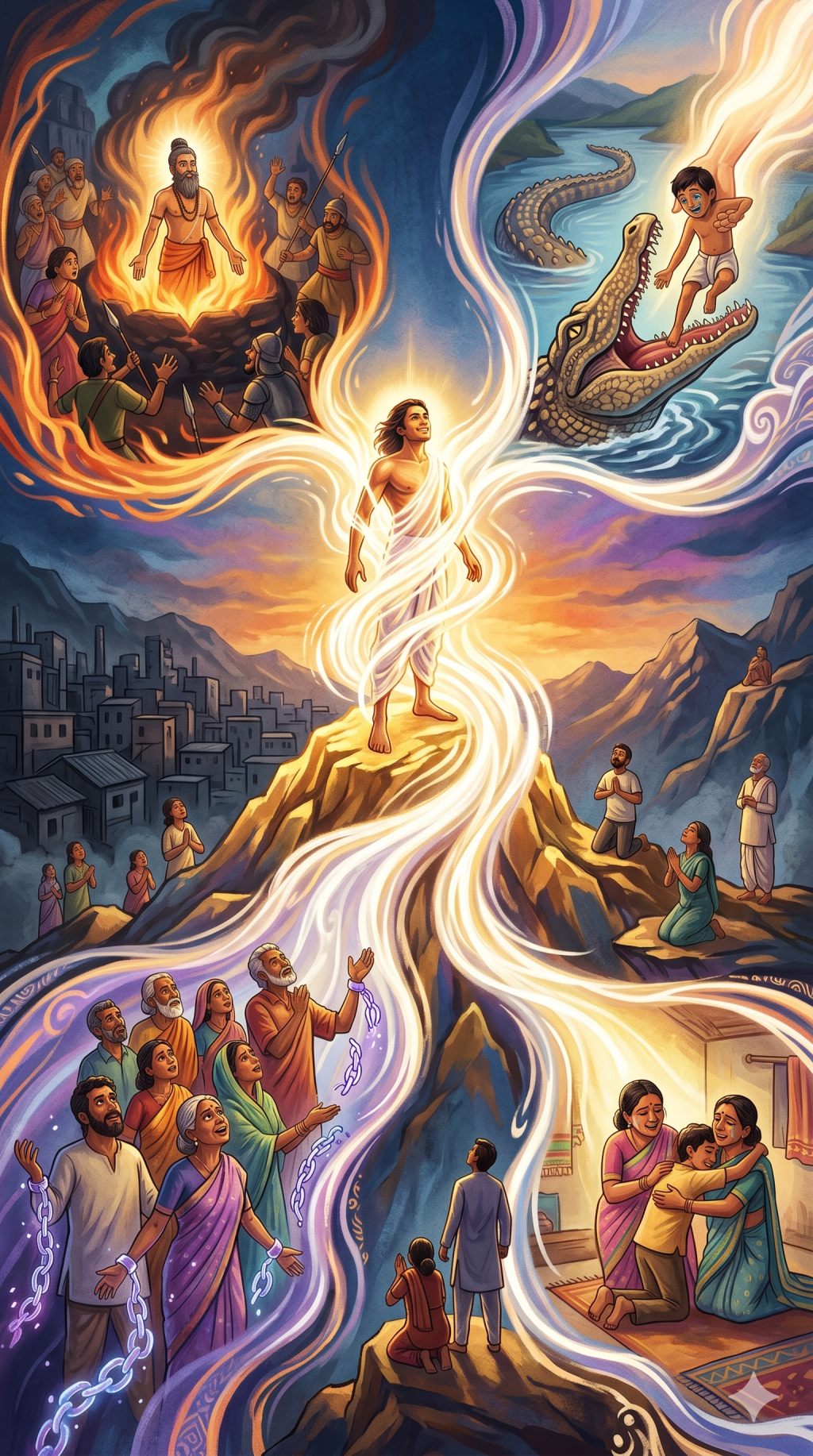
…whether it is Sundaramurthi Nayanar rescuing the boy swallowed by the crocodile, whether it is Lord Appar reviving Appoodhi Adigal‘s son bitten by a snake, or every single story that comes in the Thiruvilayadal Puranam, or calling back Siruthondar‘s son who was cut, cooked into a curry, and served on a leaf — these are all truth. They are true even today. How to make all these a truth in your life, make them possible, and make them an experience, is what I am going to share with you for these 18 days.
Stay tuned to experientially realize the Thiruvilayadal Puranam in eternal live broadcast. Along with this, I will also include the 365 Leelas of Thiruvarur. Because all of this overlaps in many places; it joins and intertwines with each other in many places. Therefore, I am adding the puranic stories of at least another ten temples along with it — Arunachala Puranam, Thirunagai Puranam, Kanchi Puranam — adding these books too, while narrating during these 18 days, I will take and tell some stories from here and there. Rather than calling them stories…
…I say they are historical facts. Stay connected. Let us together enjoy the Lord, taste Him, consume Him, blissfully celebrate, make it an experience and live it. May you attain Paramashivajnana. May you attain Paramashiva Anubhuti. May you attain Paramadvaita. Thus I bless everyone. I bless everyone to be filled in Nithyananda (eternal bliss), blossom in Nithyananda, and become Nithyananda. Be blissful. Thank you for watching — if you found the video helpful please give it a like, share with your loved ones, subscribe and click the bell icon to receive notifications.

